01/07/2026
What Recruiters Really Think When They Read Your Construction CV
Finding a job in today's UK construction industry is more competitive than ever. Whether you're applying for roles as a labourer, site manager, quantity surveyor, civil engineer, electrician, or project manager, your Construction CV is often the first impression you make on a recruiter.
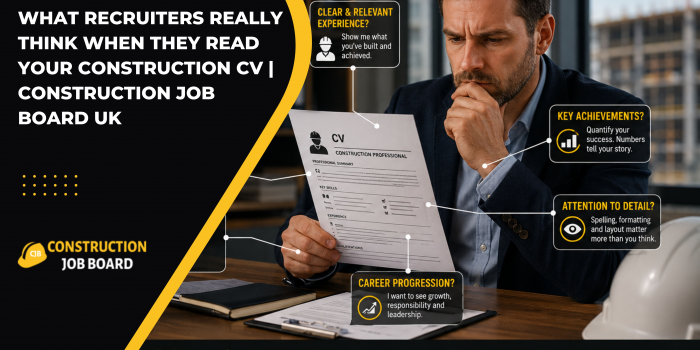
Many candidates assume recruiters spend several minutes reading every CV. The reality is very different. Most construction recruiters spend between 10 and 30 seconds deciding whether your application deserves a closer look.
That means every section of your Construction CV must immediately demonstrate that you're qualified, reliable, and suitable for the role.
In this guide, we'll explain exactly what recruiters look for, the mistakes that instantly reduce your chances, and how you can improve your CV to secure more interviews.
Why Your Construction CV Matters More Than Ever
The UK construction sector continues to face skills shortages while simultaneously attracting more applicants for popular positions. Recruiters often receive hundreds of applications for a single vacancy.
Because of this, they don't have time to read every CV in detail.
Instead, recruiters quickly scan for:
- Relevant construction experience
- Essential qualifications
- Required certifications
- Project types
- Technical skills
- Health & Safety awareness
- Career progression
- Reliability
If they don't find these within seconds, your application may be rejected—even if you're actually qualified.
The First Thing Recruiters Notice
Most recruiters begin at the top of your CV.
They're asking themselves one simple question:
"Does this person fit the role I'm recruiting for?"
Your header should include:
- Full name
- Mobile number
- Professional email
- Location
- Relevant job title
Example:
John Smith
Site Manager | SMSTS Certified | Residential & Commercial Construction
This immediately tells recruiters what role you're suited for.
Your Personal Profile Must Sell You Quickly
One of the biggest mistakes candidates make is writing generic introductions like:
Hardworking individual seeking opportunities.
This tells recruiters almost nothing.
Instead, write a concise professional summary highlighting:
- Years of experience
- Industry sector
- Major achievements
- Certifications
- Career focus
Example:
Experienced Site Manager with 12 years managing residential and commercial developments across the UK. Skilled in project delivery, contractor management, health & safety compliance, and budget control. SMSTS certified with an excellent record of delivering projects on schedule.
Within seconds, recruiters know exactly who you are.
Recruiters Look for Relevant Experience First
The experience section usually determines whether your CV stays or goes.
Instead of listing responsibilities only, explain your achievements.
Poor example:
- Managed workers
- Ordered materials
- Attended meetings
Better example:
- Managed construction teams of up to 45 workers across £8 million residential developments.
- Reduced project delays by improving subcontractor scheduling.
- Maintained 100% compliance with Health & Safety regulations.
- Successfully completed projects ahead of programme deadlines.
Recruiters want evidence—not just duties.
Numbers Catch Attention
Construction recruiters love measurable achievements.
Whenever possible include:
- Project values
- Team sizes
- Budgets
- Time savings
- Cost reductions
- Safety records
Examples:
- Managed £12 million housing development.
- Supervised 60 subcontractors.
- Delivered project 4 weeks early.
- Reduced material waste by 18%.
- Zero reportable accidents over five years.
Numbers instantly increase credibility.
Certifications Can Make or Break Your Application
Construction recruitment depends heavily on certifications.
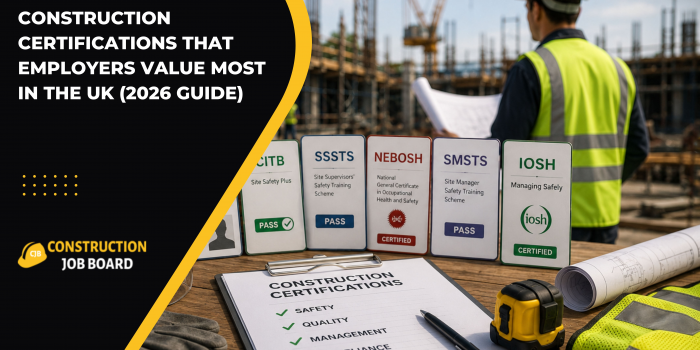
Recruiters immediately scan for:
- CSCS Card
- SMSTS
- SSSTS
- First Aid
- CPCS
- NPORS
- NEBOSH
- IOSH
- PASMA
- IPAF
If a job requires these qualifications and your CV doesn't clearly show them, recruiters may move on.
Place certifications in a dedicated section that's easy to find.
Tailor Your Construction CV for Every Job
Many applicants send exactly the same CV to every employer.
Recruiters notice this immediately.
Instead, customise your CV by matching the employer's requirements.
For example:
If applying for a Site Manager role, highlight:
- Programme management
- Health & Safety
- Contractor coordination
- Client communication
- Budget control
If applying for Quantity Surveyor positions, emphasise:
- Cost estimation
- Procurement
- Contract management
- NEC or JCT contracts
- Commercial reporting
Tailored CVs consistently perform better.
Recruiters Also Look for Stability
Frequent job changes aren't always negative.
Construction often involves fixed-term projects.
However, recruiters appreciate explanations.
Instead of leaving gaps, briefly indicate:
- Contract completed
- Project finished
- Company restructuring
- Redundancy
This avoids unnecessary questions.
Technical Skills Matter
Today's construction professionals use far more technology than ever before.
Include software you're confident using:
- AutoCAD
- Revit
- Bluebeam
- Microsoft Project
- Primavera P6
- Procore
- BIM software
- Excel
Digital skills increasingly influence hiring decisions.
Health & Safety Is Always Important
Recruiters pay close attention to health and safety knowledge.
Your CV should mention:
- Risk assessments
- Toolbox talks
- Site inspections
- CDM Regulations
- Incident reporting
- Safe working practices
Safety awareness demonstrates professionalism.
Avoid These Common Construction CV Mistakes
Even experienced candidates make avoidable errors.
Common mistakes include:
Using a Generic CV
Employers want applicants who match their vacancy.
Poor Formatting
Large paragraphs discourage reading.
Use headings and bullet points.
Spelling Mistakes
Errors create doubts about attention to detail.
Always proofread carefully.
Missing Certifications
Don't make recruiters search for important qualifications.
Highlight them clearly.
Including Irrelevant Information
Focus on construction-related achievements.
Remove outdated or unrelated work experience unless it adds value.
Keywords Help Your CV Pass Applicant Tracking Systems (ATS)
Many construction employers now use ATS software before a recruiter even reads your CV.
Include keywords naturally throughout your document.
Examples include:
- Construction Project Management
- Site Management
- Groundworks
- Civil Engineering
- Commercial Construction
- Residential Construction
- Health & Safety
- NEC Contracts
- Quantity Surveying
- Construction Planning
Avoid keyword stuffing—write naturally while ensuring important terms appear where relevant.
Soft Skills Recruiters Value
Construction is about people as much as projects.
Recruiters also assess:
- Leadership
- Communication
- Problem-solving
- Organisation
- Time management
- Teamwork
- Conflict resolution
- Decision-making
Whenever possible, support these skills with real examples from your experience.
Keep Your Construction CV Concise
Long CVs rarely perform well.
As a guide:
- Entry-level candidates: 1–2 pages
- Experienced professionals: 2 pages
- Senior management: Up to 3 pages if necessary
Every sentence should add value.
Should You Include a Cover Letter?
Yes—especially for senior or specialist construction roles.
A strong cover letter allows you to explain:
- Why you're interested in the company
- Relevant project experience
- Career achievements
- Availability
It also demonstrates professionalism and genuine interest.
Final Checklist Before Sending Your Construction CV
Before applying, ask yourself:
✔ Is the job title clear?
✔ Does my profile summarise my experience?
✔ Have I highlighted my certifications?
✔ Have I included measurable achievements?
✔ Is the CV tailored to this role?
✔ Have I checked spelling and grammar?
✔ Is the formatting clean and easy to read?
✔ Does the CV include relevant keywords?
✔ Are my contact details correct?
✔ Would I hire myself after reading this CV?
If the answer is yes, you're giving yourself the best possible chance of securing interviews.
Conclusion
Your Construction CV is much more than a list of previous jobs—it's your personal marketing document. Recruiters often make decisions within seconds, so clarity, relevance, and professionalism are essential.
By highlighting measurable achievements, showcasing certifications, tailoring your CV for each application, and demonstrating both technical and soft skills, you significantly increase your chances of progressing to the interview stage.
In a competitive construction market, a well-crafted Construction CV can be the difference between being overlooked and being invited to discuss your next career opportunity. Invest time in refining your CV, keep it updated, and ensure every application reflects the specific role you're targeting. The effort you put into your CV today can lead to better job offers and long-term career growth.
Frequently Asked Questions (FAQs)
1. What should a Construction CV include?
A strong Construction CV should include your contact details, professional summary, work experience, key achievements, qualifications, certifications (such as CSCS or SMSTS), technical skills, and relevant software knowledge. Tailoring your CV to each job application also improves your chances of success.
2. How long should a Construction CV be?
Most recruiters prefer a Construction CV to be between one and two pages. Senior professionals with extensive experience may use up to three pages, but every section should remain relevant and concise.
3. What are the biggest mistakes candidates make on a Construction CV?
Common mistakes include using a generic CV, failing to highlight certifications, listing responsibilities instead of achievements, poor formatting, spelling errors, and not including relevant keywords that Applicant Tracking Systems (ATS) search for.